
The Unhappy Bride
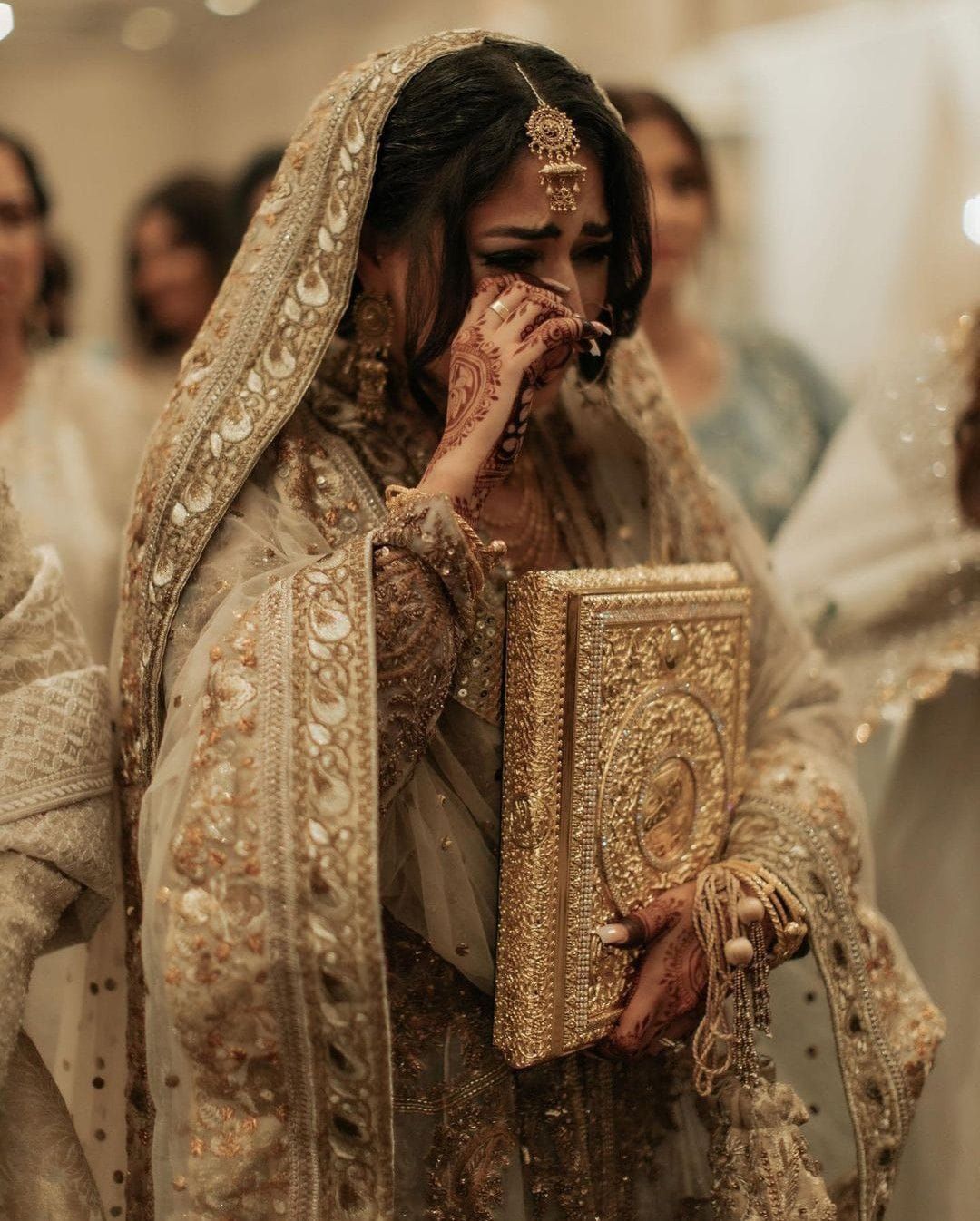
My sister Khadija made the unhappiest bride I have ever seen. Beautiful, yes. But unhappy. Her kohl-rimmed eyes brimmed with near tears. She had not yet made it out to the stage, but her kohl had started to spread beneath her eyes. I picked a cotton swab, made my way to her, put one hand on her shoulder, and the other through her eyes, attempting to clean the kohl that was starting to spread. A tear escaped her eye. I swallowed. Tears were threatening to come to my face as well. Lucky for me, I was not wearing any kohl. Lucky for me, I was not the one getting married either. “It’s not too late, you know”, I said quietly. Almost like a whisper. I drew in a breath when I said this. Her reaction evoked a humourless laugh and almost a look of pity for my naivety. “I am wearing my bridal dress, baarat ka jora,” she stated, in a matter-of-fact way, declaring that it was indeed too late.
“He does not deserve you,” I stated, sadly. My sister’s groom-to-be was eleven years her senior. He had balding hair, a certain maturity that my sister at the age of twenty-three did not possess. He had already gotten a divorce and had a child from the previous marriage who lived with his ex-wife.
My sister was vivacious, carefree, joyful, bubbly, and extremely gorgeous. All up until the age of twenty-two. On the way back from her university, she had stopped to grab a bite with a few of her classmates. Male classmates included. A nosy relative had seen her share a carefree laugh with a classmate and told other, nosier relatives. It became a whirlwind of rumours and tongues wagging. It reached my father’s ears not long after that. He was raising the two of us after our mother died, giving birth to me. A lot of these same nosy relatives told him not to send us to coeducation or even for higher education. He did not listen to them, but he gave us clear and strict instructions. We were not to engage with any male classmate, even for academic purposes. Our number was not to be shared in any WhatsApp groups, wand e were not to have social media accounts. We shared a cellphone, which used to be mostly with Khadija. Up until last year, that is. Now it is with me. We thought our father had too much pressure on himself as he did not have a partner to help him raise us, and was scared about our reputation or “izzat”. We sympathised with him. We truly did. But I was sixteen, she was twenty-two. Enough was enough. What harm would a little rebellion do?
One Instagram account, no pictures of us- just of sceneries, but the accounts would be in our names, of course. We needed to be added to WhatsApp groups. Of course, we did. We needed to receive day-to-day information through those. I remember missing out on a quiz because I was not added to the WhatsApp group of my class. Khadija had gotten poor evaluations from her peers due to not engaging with them in group projects. Our father is old-fashioned, we thought. Everyone knows these things are normal, perfectly normal. We reasoned with each other over and over again, each giving the other the validation of why this had to be done.
Slowly, those sky pictures became pictures of us, but our faces wouldn’t be visible. Until they were. One selfie, who would that hurt? Then came the day Khadija got a friend request from Ahmed, a boy in her class. “I am obviously not going to accept,” She stated categorically. I nodded. Of course, accepting a boy’s request on social media was pushing it.
“But he is friends with some of my friends, and I have to study with him for another year as well,” She said to herself more than she did to me.
A small voice in my head asked me to stop her before she accepted. Not because I thought there was something wrong with it, I just knew it could land her in trouble. I did not say anything. I was quiet. A year later, at her wedding, I was not quiet. I told her that it is not too late. But now, it was. Even I knew that. She was going to get married today. There was nothing she or I could do to stop it. “Did you invite your friends from university?” I asked, hoping to make conversation. Khadija shook her head. “Kyun? Why?” I asked. “They will judge me, and would never understand,” She explained. I nodded; it made sense. Khadija went to one of the best universities in the country. She had gotten in on a merit scholarship, not just financial aid. Her classmates and friends led different lives, had different families, and for them, our father would be considered regressive and conservative. Maybe even we would be considered slightly regressive for agreeing to conform to these norms.
Khadija had it hardest of all. She actually wanted to fit in and make friends, unlike me, who has her wired earphones on anytime I am not in class and refuses to make extra conversation with anyone.
That follow request had led to a casual friendship, a friend group formed, lunch every day at their university, and occasionally with Khadija peeking into every corner before doing so, but having ice cream with a few of her friends.
When she would come back from these hangouts, I would notice a particularly pink tinge on her face. This glow of carefree happiness. I did not quite understand the purpose of it. But I was happy for her.
That fateful day, when our relative saw her, and tongues started wagging about our upbringing, my father was put under a lot of pressure. Khadija was going to get married, the first match that made its way to our house went back with a yes. Without asking Khadija, without even telling Khadija before finalising it.
He told her a week later. She did not protest. I really thought she would. She just came into our room and cried. I comforted her, told her maybe this is for the best. She cried harder, so I kept quiet and rubbed circles on her back. She used to do that for me when I was younger. That made me cry, and so we cried and held each other.
“You can do more,” She told me hurriedly, knowing our father could come in any minute and tell her it was time for the Nikkah. “Me? I see no scholarships for myself. At least merit ones, and I do not think I will get to go,” I told her. “You can do more, I could have as well,” She whispered. You still can, I wanted to tell her. Khadija opened her mouth again, as if to speak. Then she closed it again.
“Khadija, it is not too late,” I whispered. I had to. Or I would have beaten myself up over it.
She said something. She almost did, I would tell myself years later when I got everything that she had ever wished for. She almost said something. Maybe I could have followed up. Maybe I could have offered an actual plan instead of uttering this phrase. But that night, as she put on her earrings with her henna-covered, shaking hands, she did not say anything.
The door opened the next moment. We knew it was time. Khadija left the room. I sat there for a while, looking at myself in the mirror. I was dressed aptly for the bride’s sister. Will this be my future in five years? Or will I be able to do something more, I thought. I had to, didn’t I? Now that Khadija had said it. I took a deep breath and headed to the next room. Khadija needed me more today than my selfish pondering about my own future did. Not today, I had time to figure this out. Just as I entered the next room, the moulvi sahab had asked Khadija the fateful question. There was no pause like I thought there would be, like I had seen in old Pakistani dramas with unhappy brides. No pause at all. “Qabool hai,” she whispered softly, but clearly, very coherently. There was no pause because the pause had already occurred in the makeup room ten minutes ago. The pause was for my eyes only to remind me she had hesitated.
